 Tilework inside Shah Mosque, Isfahan.
Shakespeare is excellent, whereas AI writing is — at least, for now — dull. AIs can now write much of our code, review legal contracts, and perform various impressive feats; they have achieved gold-medal-level scores at the IMO. But, as of this writing, I am not aware of a truly interesting AI-written poem or even essay. Why?
This breaks down into two questions:
- What makes texts good?
- Why is it difficult for AI to do that?1
This essay will focus on question 1, and is thus mostly about aesthetics.
1. Surprise
One of the things that so offends us about AI 'slop' images is a sense that the details don't matter. The cup is green, but it may as well have been blue. In good human works, every detail feels carefully chosen. Arbitrarily changing a color in a Hopper painting would make it worse.
You can put this in terms of compression. A cliche illustration of, say, a vase of flowers can just be described as "imagine a New Yorker cartoon of a vase of flowers". But a really good painting of a vase of flowers can only be captured by seeing the painting itself: nothing else will substitute. Great artworks are hard to compress (i.e. have high information content); slop is easy to compress. When you type a few short sentences into an AI image generator and it makes you an image for your blog post, you are likely generating slop because you are injecting relatively little information yourself. 2
Another word for 'high information' is 'surprising'. Thus:
One can explain this using the predictive processing model of the brain. As we are scanning a text, our brain is constructing the meaning and predicting the next several words. Where there is no surprise — where something is perfectly predictable, or fits some pattern that we know — our brain registers only dullness. When our expectations are violated in a way that's satisfying to resolve, we get pleasure and novelty.
The essayist Henrik Karlsson cites the sentence "an interesting and exciting finding" as an example of bad prose, because:
"the word "exciting" is sort of implicated by the word "interesting". They are not synonyms, but if I had blanked "exciting" and asked you, or a language model, to fill it in, "exciting" would have a high probability. So it is not adding all that much information—the reader already has that adjective implicitly in their head."
Compare the famous passage from Macbeth, where both of the bolded words are famously surprising:
Will all great Neptune's ocean wash this blood
Clean from my hand? No, this my hand will rather
The multitudinous seas incarnadine,
Making the green one red.
Hence, too, the story of the writing professor who would give his students a copy of the below stanza from Larkin's The Whitsun Weddings with many words blanked out, and ask them to guess those words, and claimed that nobody had ever gotten 'hothouse' or 'uniquely':
All afternoon, through the tall heat that slept
For miles inland,
A slow and stopping curve southwards we kept.
Wide farms went by, short-shadowed cattle, and
Canals with floatings of industrial froth;
A hothouse flashed uniquely3: hedges dipped
And rose…
The value of surprise is more obvious in visual art. In his four-volume work The Nature of Order, the architect Christopher Alexander gives this example from a Fra Angelico painting:
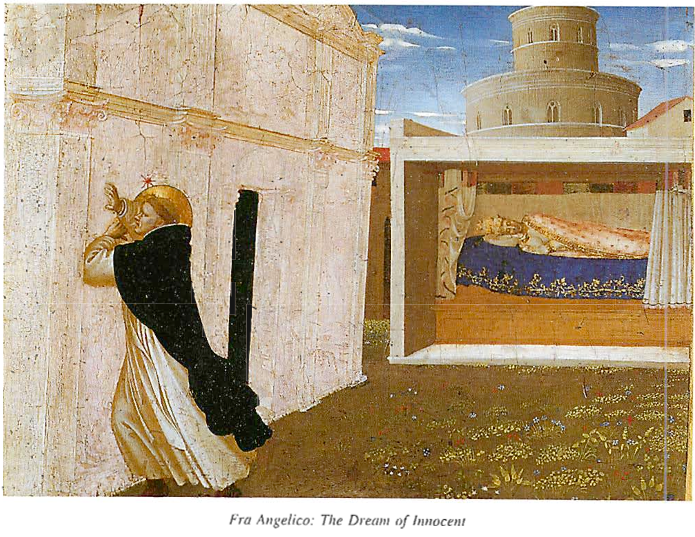
Alexander asks us to cover up the black stripe on the priest's robes and the door, and imagine we were the painter:
Imagine some moment before the black of the door and priest's robe had been painted, but when everything else is more or less already there...You can see what I mean by putting your hand over the picture, so as not to see the black parts. Do you see that the picture loses much of its haunting character...can you see how immensely surprising it is?
— Christopher Alexander, The Nature of Order, Book 4, p. 133
The surprise principle operates in other ways, too. We barely see everyday objects because we are so used to them (low novel information again), but great art can make you see these objects afresh, the way a child might. This too is a kind of surprise, sometimes called defamiliarization. This is a favorite technique of Tolstoy's, who often takes a normal action that we are all familiar with, and describes it the way an alien might. Thus he describes a person being whipped as "to strip people who have broken the law, to hurl them to the floor..." and so on, deconstructing the action without ever using the word 'whipping'. This makes you feel the action much more viscerally than if he had just used the word to summarize it.
These are all familiar points to lovers of art. But the surprise principle operates at even deeper levels, below even our conscious perception.
Take grammar: while we are reading, our brain is constantly making guesses as to the grammar of the sentence, and the best writers are always at work violating those expectations, too. This is a trickier point to illustrate, because it happens so fast and seems so effortless that to slow it down starts to feel tedious.
Read, for example, Hamlet's famous soliloquy slowly:
To be, or not to be
On reaching the end of line 2, your brain resolves a complete sentiment: “whether it is better to suffer in the mind.” “To suffer” feels intransitive — a closed thought.
← → to explore
On reading line 2, your brain resolves it into a complete sentiment — "whether it is better to suffer in the mind". But then comes:
The slings and arrows of outrageous fortune...
As soon as you start line 3, though, you realize 'suffer' was actually taking line 3 as its object, so the real meaning is something like "whether it's better to silently suffer the slings and arrows etc."... Your brain quickly executes a flip to a new understanding of the sentence.
Shakespeare is constantly doing this. It is one of the most important features of his writing that our minds are having to work hard to make sense of what he is actually saying, and this process happens quite fast and unconsciously precisely because he is destabilizing the reader with these types of ambiguous constructions.
Because this all happens very fast, though, very few people notice or point out that this is happening.
What dreams may come
Line 1 sounds standalone — “what dreams may come?” feels like an exclamation of wonder, a complete utterance. Your mind closes the thought there.
← → to explore
The first line sounds standalone — "what dreams may come?" seems like the end, an exclamation of wonder — and then the third line ("must give us pause") actually continues the first, which we thought had ended, so that the meaning is more like "the dreams that might come after we end our lives should make us hesitate".
Cognitive scientists have termed these garden-path sentences. But I think deeming this a special 'type' of sentence pathologizes what is actually a very common experience in great poetry: it is impossible to read a single Shakespeare sonnet without encountering at least one of these. As you read, your mind is conjecturing the grammar of a sentence; Shakespeare likes to violate these expectations, and does so frequently. Many readers take this as an artifact of the fact that he's a writer from a different era. But my claim is that most great writers use this effect.
This property of constantly destabilizing the reader is, I think, also a general property of great works of art. They are constantly breaking their own forms, subverting them, playing with the reader in a way that requires us to rise to their level. They are extremely strange. Think of the experience of reading Moby-Dick and getting hit with sixteen pages of quotations about whales straight off the bat. New art finds new ways of doing this, which is why art is always this forward motion in which old forms get disrupted by new ones, and artists must continue finding ways to be original. Although I believe some texts are objectively better than others, and that this is demonstrable, I also believe that there will never be some exact recipe for generating more great texts, because one of the characteristics of greatness is that the next great work never looks like the last one.
My main argument in this section has been that surprisingness, or strangeness, operates at many different levels in the art we value: word choice (or color choice), grammar, sentence, plot, form, and so on. This strangeness is essential for the effect of great art, because we like to make sense of things, and if we make sense of things too easily they are not interesting to us; great works of art are therefore necessarily somewhat difficult to grasp the meaning of, their meanings are multiple and constantly shifting, and they require a pleasant kind of effort to make sense of.
To go back to AI, all of this gives us some sense of why LLMs aren't great writers by default. At the word level, they tend to pick relatively 'obvious' choices. Thus, I ask the model currently considered the best AI writer: "write a descriptive paragraph about a day in the park" and it starts with: "A warm afternoon unfolds in the park, where sunlight filters through the canopy of old oak trees and dapples the ground in shifting patterns of gold and green".4 Note that this is the most cliche possible detail to have picked, and the word 'dapples' is the most common word to use in this context; in short, the whole thing is unsurprising.
And yet: you cannot fix this problem simply by asking the AI to be more surprising. Why?
2. Echoes
The eye is the first circle; the horizon which it forms is the second; and throughout nature this primary figure is repeated without end. It is the highest emblem in the cipher of the world. St. Augustine described the nature of God as a circle whose centre was everywhere and its circumference nowhere. We are all our lifetime reading the copious sense of this first of forms…
— Ralph Waldo Emerson, Circles
The most surprising sequence of numbers is a random one, but a random sequence of numbers is not great art. You need more than just surprise. The details of great artworks relate to each other somehow. They are chosen in such a way that they cohere with each other at multiple levels.
Great works are full of patterns. They are as intricately patterned as Persian rugs or Norwegian stave churches.
This is easiest to see visually. For example, here are two of the rose windows at Chartres; note how the elements echo5 each other, but not in obvious ways:
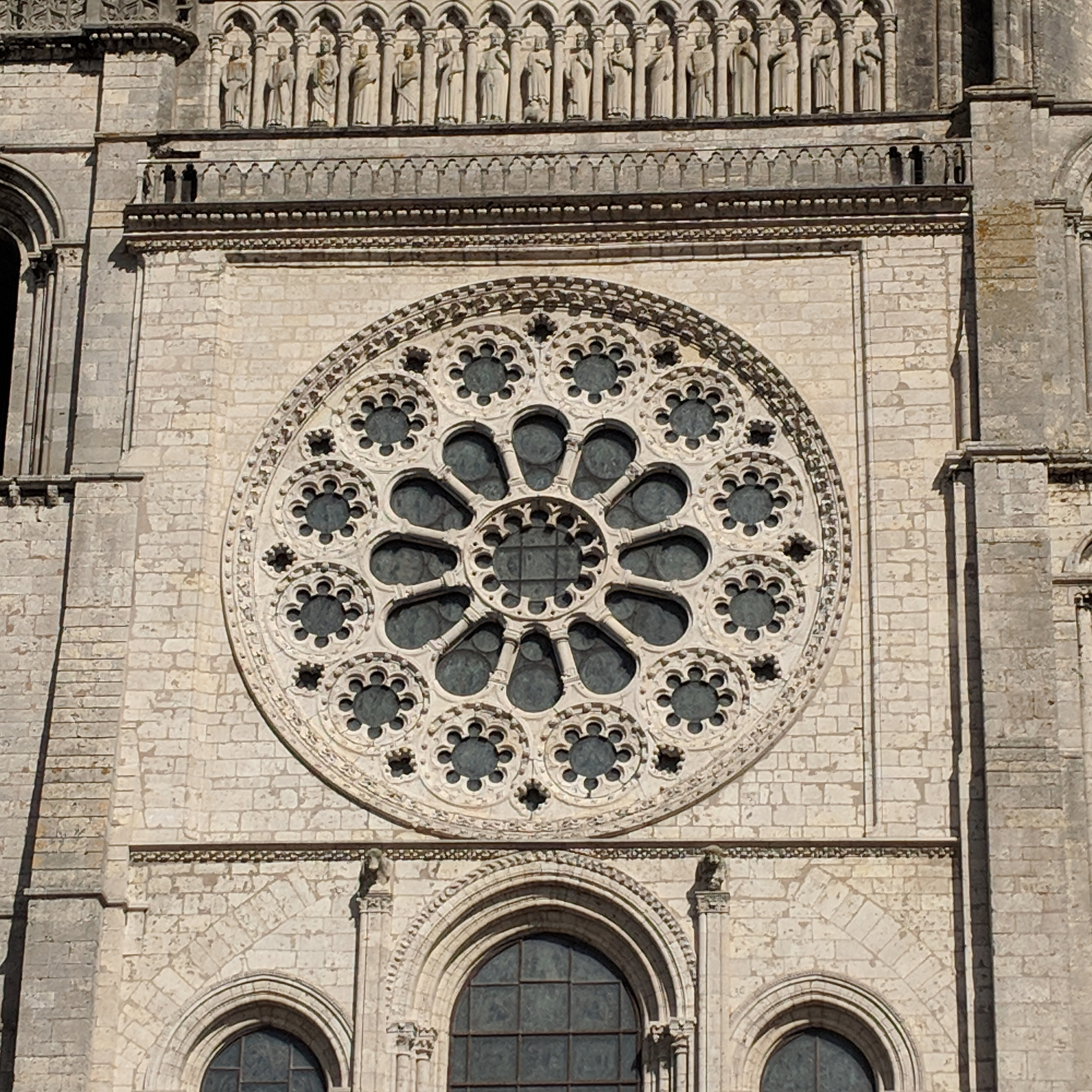
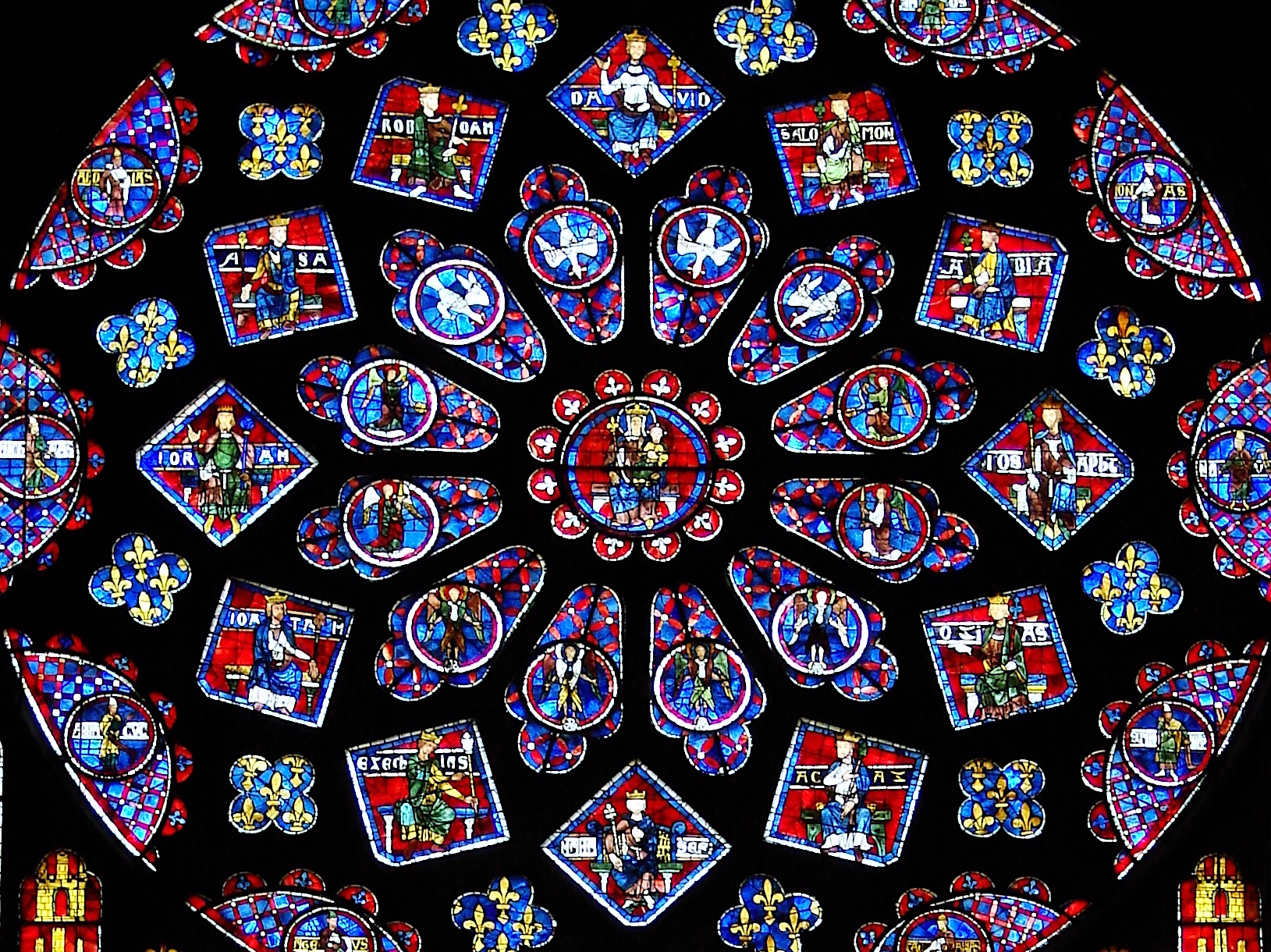
This is often harder to spot in verbal artifacts, but it is this feature that I think distinguishes really good works of art from merely 'ok' ones.
Most of us are familiar with the surface level ways of doing this: rhyme, for example, knits together different lines of a poem in a semantically irrelevant way that nevertheless makes it feel like part of a unifying whole. Same with assonance and other such effects most of us are familiar with from English class. It is echoes, for example, that make so many verses from the King James Bible so pleasing and beautiful to listen to:
“Arise, shine; for thy light is come, and the glory of the Lord is risen upon thee.” (Isaiah 60:1)
Note the echoing vowel sounds throughout in 'arise', 'shine', 'light', and 'thy'. Rhyme and assonance are verbal echoes.
In music, the most famous example perhaps is Beethoven's Fifth, with its famous "ba-ba-ba-BUM" theme; the short-short-short-long statement in the beginning then echoes through that movement in thousands of ways, sometimes stretched, sometimes slowed down, so that the whole movement feels like an organic thing that has grown from that single seed.
Good art layers these, one on top of another, to build up artifacts of stunning complexity. These are the text equivalents of Gothic cathedrals. Each layer alludes to other layers, too, adding more and more constraints, until you get an artifact where changing any one word does violence to the whole.
To see this density in action, let's look at Shakespeare's Sonnet 15. Click through the layers to see how a single fourteen-line poem simultaneously participates in half a dozen independent systems of meaning — sonic, structural, thematic, and more.
Sonnet 15
Each color connects a rhyming pair. Note how grows/shows and moment/comment share an ‘o’ sound across rhyme groups — the formal boundaries are already blurring.
← → to explore
Echoes are sewn through sophisticated literary works in more subtle ways, too.
Thus Nabokov, in his Lectures on Literature, points out that Anna Karenina is filled with trains and railway images even apart from the fact that the main plot points occur at railway stations; Kafka's Metamorphosis is filled with occurrences of the number three.6 Lots of movies and books use Christian symbolism this way — crosses, doves, and so on. Macbeth is full of birds (ravens, crows, bats, owls, the Thane of Cawdor...).
Sometimes these symbols are significant, as in the Christian symbolism; and sometimes they are insignificant, as in the number three; but either way, the density of these symbols strewn throughout a work give it an additional coherence that would be lacking if you wrote down things at random. It gives it the same type of coherence that you see when you look at a beautiful tree, or a grassy field: things feel right. This feeling of rightness is achieved through these echoes.
Sometimes writers take this to comical lengths. Again, most people never notice this, nor do they need to. The most amusing example I am aware of is from the critic Stephen Booth, who has suggested that Shakespeare appears to have been partial to play-long, alliteration-like repetitions of words capable of reference to body parts — and that the whole of Hamlet is studded with references to ears. This may seem like a reach, but it is true: the word "ear" and its variants (hear, heard, hearing, ears) appear eighty-four times in the play:
- Claudius murders Hamlet's father by pouring poison through his ear.
- The Ghost says his tale must not be told "to ears of flesh and blood"; in the same speech he says "the whole ear of Denmark is by a forged process of my death rankly abused"; and when describing the murder, "in the porches of my ears did pour…"
- Hamlet describes Claudius as "like a mildew'd ear / Blasting his wholesome brother." (The 'ear' here is an ear of corn, infecting its neighbor.)
- Polonius hides behind an arras to overhear Hamlet and Ophelia — "placed in the ear / Of all their conference", and more generally the play is full of people overhearing things.
- The ghost arrives and speaks to Hamlet: "Speak; I am bound to hear." The Ghost replies: "So art thou to revenge, when thou shalt hear."
- At the end of the play, we have "The ears are senseless that should give us hearing."
And on and on. This may seem like a stretch, but I had an AI perform this analysis across Shakespeare's plays and found it to be true. 7
It doesn't matter for my argument if this was intended or not. Great literary works are full of these hidden patterns, which silently create a kind of electric charge of coherence across the text as you are reading, and which contribute to the feeling that we are reading something intentionally knit together as an aesthetic whole.
These echoes cannot be too obvious — rhymes, for example, can often sound childish in the wrong hands. They must be surprising and numerous. This is very hard to do, which forms part of the answer to why it might be hard to make great AI writing: not only do you have to surprise readers in interesting and precise ways, but you also have to make sure that multiple patterns cohere across the entire work and are not simply local and uncorrelated.
3. Depth
There's a feeling of limitless depth that is unique to the really great works: it feels like you can always find more patterns, more coherence, more beauty on rereading. Or that more readings will give you a deeper understanding, but never a perfect or complete one. Thus:
It is difficult to understand exactly how or why this is created, but there are a few facets to it that are worth pointing out.
At the simplest level, this is about layering. One thing that creates this feeling of depth is multiple layers of patterns or organization that relate to each other, often in ways that create a combinatorial explosion of possible readings; this allows us to experience different levels of the same work on each reading.
There's a stunning analysis of Shakespeare's Sonnet 40 by Stephen Booth, in which he takes one line — "Then if for my love thou my love receivest" — and points out it can be glossed in at least seven different ways:
- If, out of affection for me (for love of me), you take my mistress
- If, because of my affection for you, you courteously welcome ("receive") my mistress
- If, in place of my affection, you take my mistress
- If you understand my mistress to be my true love
- If you understand what I feel for my mistress to be love
- If, because of my affection for you, you accept my affection
- If, for yours, you take my mistress
You can reread that line and 'focus' each meaning in that list if you concentrate hard enough, though it is very difficult. The point is that the sentence packs all of those meanings in it and more; most of us are not conscious of most of those meanings, nor do we pause to think about it; but the meanings are there, and create what I'm calling depth, a sense of a kind of bottomless truth in the writing.
A different type of layering from this kind of 'stacking' of meaning is the idea of the same work containing diametrically opposed interpretations. Some of the most interesting art has a surface level meaning, but then a second 'hidden' layer of meaning that contradicts the first layer. Many have pointed out that Milton's Paradise Lost makes Satan look incredibly cool and the poetry surrounding him is some of Milton's best and richest, whereas Adam and Eve are rather dull by comparison, even though the poem is meant to be condemning Satan.9
Interesting non-fiction works this way, too. The whole idea of a 'Straussian' reading of a work is that it suggests a hypothesis while silently contradicting that hypothesis, with only a select few able to discern the real meaning. I will give a few more examples of this type of depth:
- The movie Parasite is ostensibly about the poor's inability to escape their lot due to structural inequality and oppression by the rich, but people have noticed that the movie goes out of its way to make the poor look bad and the rich sympathetic in ways that suggest the opposite interpretation, namely that the poor are the way they are because they have odious moral character, and the rich are the way they are because they are morally better. The movie is good because it contains both interpretations — perhaps against the intent of its own director —, and it's possible to see it either way. (Incidentally, 'smell' is a constant theme in that movie, as the MR review points out.)
- It is interesting to read Plato's Apology as, in fact, a condemnation of Socrates rather than a defense, whether or not it was meant that way.
- Peter Thiel somewhere says that the hidden message of his Zero to One book — normally taken as an entrepreneur's bible — is "perhaps you should not be an entrepreneur".
Another facet of depth is mystery. Good art is always a bit under-explained. It allows you to speculate. Characters may have multiple motives. The critic Auerbach famously analyzes the Bible story of Abraham sacrificing his son, and points out that the narrative does not explain much of anything, it just gives you the bare facts; Kierkegaard then spends all of Fear and Trembling trying to explain Abraham's motivations, and concludes that they cannot be explained, that his sacrifice is an act of pure faith ("I cannot understand Abraham. I can only admire him"). We never really understand whether Hamlet is actually crazy. Many works even sprinkle in fundamentally inexplicable details, which then drive people crazy when they try to make coherent sense of them.
4. And yet...
I remember always being puzzled by Ezra Pound's statement that great poetry is "language charged with meaning to the utmost possible degree", and I think I've made some headway in understanding that better. To 'charge' language with meaning means to use it in these ways: to be surprising, to have a work with layers of patterns, and to produce something with great depth.
And yet, though I've pointed out many features of great art, there is still some mystery to it. This is, I think, the link between art and life. There's a certain weight to someone having had an experience — or having imagined something — and then having written that down in this way. It's the type of weight you feel when a grandparent tells you a story that's important to them, or when someone shares something especially vulnerable that happened to them.10 This is, ultimately, why I think human art will continue and even improve in the age of AI: AI cannot experience things for you. Art, at its best, is in part about these most spiritually weighty human experiences, and this component of greatness is not reducible to any formal factors, because it is life itself.
My thanks to Tyler Cowen and Henry Oliver for reading a draft of this piece.
- 1. You will notice I am careful not to say that AI "cannot" do that. This is because I think AI probably can do it, or somebody probably can use AI to do it, eventually. It's just not easy. ↩ back
- 2. See Gwern for a more detailed explanation of this. ↩ back
- 3. 'Uniquely' is a perfect word here for a few reasons. First, the poem is about transience, and moments that will never recur again, and 'uniquely' compresses that into a single word, i.e. this hothouse will never flash in this way again. Second, it slows the rhythm of the sentence down as you read it out loud, mirroring both the uneven pace of English countryside trains and also, in a movie-like way, making your mind pass in slow motion through the hothouse flashing in the sun. The line thus enacts, in microcosm, the sensation around which the entire poem is based. This is also, of course, an instance of the 'echoes' / fractals pattern I point out later on in this essay. ↩ back
- 4. Claude Opus 4.6. ↩ back
- 5. Alexander again: "In the course of examining things which have profound life, I have found that there is almost always one vital characteristic, very hard to describe accurately, and yet crucial. In general terms, there is a deep underlying similarity — a family resemblance — among the elements, so deep that everything seems to be related, and yet one doesn't quite know why, or what causes it. That is what I mean by 'echoes.'" (The Nature of Order, Book 1) ↩ back
- 6. "The number three plays a considerable role in the story. The story is divided into three parts. There are three doors to Gregor's room. His family consists of three people. Three servants appear in the course of the story. Three lodgers have three beards. Three Samsas write three letters…" (Vladimir Nabokov, Lectures on Literature) ↩ back
- 7. He does this with other plays too, e.g. The Tempest is full of plays on the word "hair" (heir, Ariel, 'airy', 'air', and so on). ↩ back
- 8. Gwern cites Gene Wolfe: "My definition of good literature is that which can be read by an educated reader, and reread with increased pleasure." ↩ back
- 9. William Blake: "The reason Milton wrote in fetters when he wrote of Angels & God, and at liberty when of Devils & Hell, is because he was a true Poet and of the Devil's party without knowing it." ↩ back
- 10. A film sequence that feels like the thing I'm gesturing at here is the final scene in No Country for Old Men, with Tommy Lee Jones narrating his dream. ↩ back